Showing posts with label Germany. Show all posts

Wednesday, 27 February 2013

Nearly three quarters of Germans support same-sex marriage, according to a poll published on Wednesday, as Chancellor Angela Merkel's conservatives weigh up extending more rights to homosexual couples ahead of a September election.

Berlin Mayor Klaus Wowereit (first row 2nd R), U.S. Ambassador to Germany
Philip Murphy (first row 3rd R), Britain's ambassador to Germany Simon
McDonald (first row L) and the Green Party parliamentary faction co-leader
Renate Kuenast (first row 2nd L) open the Christopher Street Day (CSD)
parade in Berlin, June 23, 2012. The annual street parade parade is a celebration of
lesbian, gay, bisexual, and transgender lifestyles and
 denounces discrimination and exclusion.


Nearly three quarters of Germans support same-sex marriage, according to a poll published on Wednesday, as Chancellor Angela Merkel's conservatives weigh up extending more rights to homosexual couples ahead of a September election.

The survey for RTL television and Stern magazine suggested 74 percent of Germans were in favour of allowing homosexuals to marry and 23 percent against.

Support is strongest among people voting for the opposition Greens and centre-left Social Democrats (SPD) but even among those backing Merkel's Christian Democrats (CDU), almost two-thirds were in favour, the poll showed.

The CDU wants to boost its appeal among urban voters as it gears up for this year's vote.

Merkel's government is preparing to amend the law to grant same-sex couples greater adoption rights after Germany's constitutional court ruled last week that gay people should be allowed to adopt a child already adopted by their partner. Heterosexual couples already have the right.

The court has given the government until July 2014 to amend the law.

Last weekend, a close Merkel ally hinted that the party may also be ready to abandon its opposition to giving gay couples the same preferential tax treatment as married heterosexuals.

Homosexuals in Germany can form civil partnerships but cannot marry. Opposition parties accuse the CDU, staunch advocates of traditional family values, of dragging their feet on gay rights.

The CDU's more conservative Bavaria-based sister party, the Christian Social Union (CSU), has warned against rushing to change the law.

Earlier this month, the lower houses of parliament in both France and Britain voted in favour of gay marriage.

(Reporting by Gareth Jones; Editing by Tom Pfeiffer)

Wednesday, 20 February 2013

Germany: Gay adoption laws strengthened for civil partners

Germany’s highest court ruled today that one member of a civil partnership should be able to adopt their partner’s stepchild or adopted child.


Until now, same-sex couples could only adopt their partner’s biological child.

The new gay adoption laws are now in line with rules that apply to heterosexual couples and judges ruled that this was discriminatory.

Government legislation is to be drawn up by June 2014.

The historic ruling has been hailed as “a breakthrough in equal treatment” by Volker Beck, an openly gay senior lawmaker with Germany’s opposition Green Party.

However, the ruling only means that same-sex couples can adopt the same child on an individual basis and not as a couple and they still cannot adopt unrelated children.

“Today’s decision marks a historic step finally to put rainbow families in Germany on a comprehensive, secure legal footing,” Justice Minister Sabine Leutheusser-Schnarrenberger said. “Full adoption must be the next step.”

Same-sex civil partnerships have been legal in Germany since 2001.

In August, German Chancellor Angela Merkel rejected calls to give to LGBT�couples�the tax breaks�enjoyed�by heterosexual married�couples.

Tuesday, 27 December 2011

Guido Westerwelle, German Vice Chancellor

27 December 1961


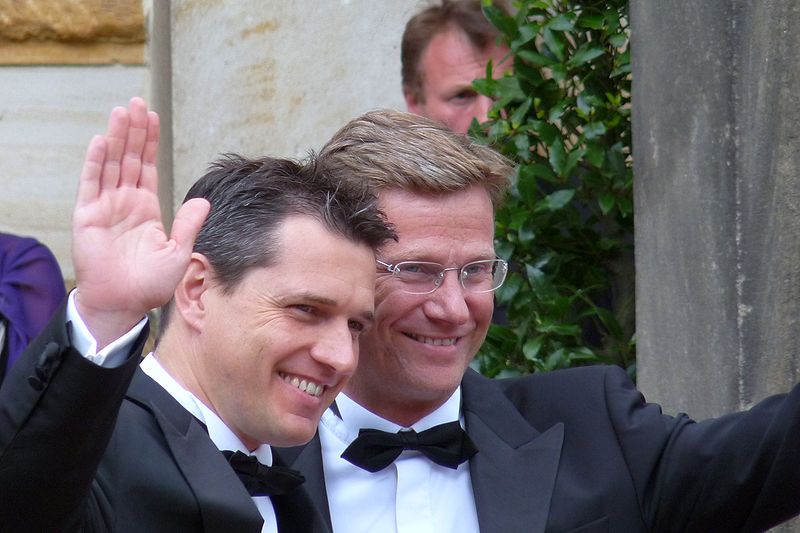
Guido_Westerwelle (right)  and partner Michael Mronz  (L)

Guido Westerwelle is a German liberal politician, currently serving as the Foreign Minister and Vice Chancellor of Germany in the second cabinet of Chancellor Angela Merkel (since 28 October 2009). He is the first openly gay person to hold either of those positions. Since 2001, he has been the chairman of the Free Democratic Party of Germany. A lawyer by profession, he has been a Member of Parliament since 1996.

Westerwelle joined the FDP in 1980. He was a founding member of the Junge Liberale, the youth organization of that party, and was its chairman from 1983 to 1988.

Having been a member of the Executive Board of the FDP since 1988, he first gained national prominence in 1994, when he was appointed Secretary General of the party. As such, he was a notable proponent of an unlimited free market economy and took a leading part in the drafting of a new party programme.
In 1996, Westerwelle was first elected a member of the German Bundestag, filling in for Heinz Lanfermann, who had resigned from his seat after entering the Ministry of Justice. In 1998, Westerwelle was re-elected to parliament.
In 2001, he succeeded Wolfgang Gerhardt as party chairman, who however remained chairman of the FDP's parliamentary group. Westerwelle was then the youngest chairman in the party's history,
Until 2004 he was not openly gay, although this was fairly common knowledge in the general public. On 20 July 2004, Westerwelle attended Angela Merkel's 50th birthday party accompanied by his partner, businessman Michael Mronz, thereby tacitly acknowledging that he was gay. It was the first time that he attended an official event with his partner. Today, he is frank about his homosexuality and lives together with his partner Michael Mronz. The couple registered their partnership on 17 September 2010 in a private ceremony in Bonn


Enhanced by Zemanta

Tuesday, 20 December 2011

Gay Marriage for Germany, France?

While the bulk of English language reporting on gay marriage has focussed on three English - speaking countries, the state level battles in the US, the promise of equality for the UK, and on the political push in Australia, there is also important movement in several European countries. Denmark and Finland have expressed their intention to introduce enabling legislation (in 2012 and 2013 respectively), and Luxembourg has already introduced legislation - it is just not clear when the process will be concluded.


Now, there are encouraging reports of progress in the European Union's two major countries, Germany and France:

Monday, 26 September 2011

First gay Turk elected to German Parliament (Armenia News)


"Hakan Tas – a journalist and gay rights activists was elected to Berlin Parliament from The Left (Die Linke) party.

In his interview to Turkish Hurriyet Daily News Tas noted that Turkish President Abdullah Gul congratulated him during his visit to Germany."

“People in Germany are used to gay politicians; the mayor of Berlin is gay, as is Germany’s ministry of foreign affairs. As a rough estimate, we assume that some 8 percent of the 2.5 million Turks here are gay. However, not everyone is open about their sexual identity and this is not an easy thing to do,” Tas said.

He mentioned that about five thousand people joined the annual gay parade held in Istanbul.

Tas characterized the banning the access to two major LGBT sites, the official websites of gay organizations Kaos GL and LambdaIstanbul by the Turkish Parliament as violation of human rights.

“That’s definitely against human rights and it is a big mistake by the Parliament. These are legal associations approved by Turkish authorities. Turkey needs to let its politicians do politics freely.”