Showing posts with label homoerotic art. Show all posts

Wednesday, 12 December 2012

The Art of Paul Cadmus: "What I Believe"

"What I Believe" (1947-1948) by Paul Cadmus (died December 12, 1999) was inspired by E.M. Forster's essay of the same name, in which the novelist expresses his faith in personal relations and his concept of a spiritual aristocracy "of the sensitive, the considerate, and the plucky. Its members are to be found in all nations and classes, and all through the ages, and there is a secret understanding between them when they meet. They represent the true human condition, the one permanent victory of our queer race over cruelty and chaos."

Note the happy, sun-drenched same-sex couples on the left, and the miserable mixed sex couples on the right.

More by Paul Cadmus below the fold:

Thursday, 26 July 2012

The Male Nudes of Photographer Greg Gorman

Photographer Greg Gorman built his career, and is best known as, a photographer of celebrities, but in 2000 he published a book of male nudes, "for his own pleasure".


Tuesday, 8 November 2011

"A Night in the Desert", George Quaintance

"Night in the Desert--1951" is one of the first of the iconic paintings of George Quaintance, who died November 8, 1957.
Although now obscure, George Quaintance was one of the most influential figures in a unique American style of art and one of the most flamboyant and interesting gay characters for four decades of the twentieth century.


Though few people outside the gay world know it, Quaintance was a pioneer of male physique painting. This genre heralded a new American gay consciousness in the early 1950s.

Friday, 17 December 2010

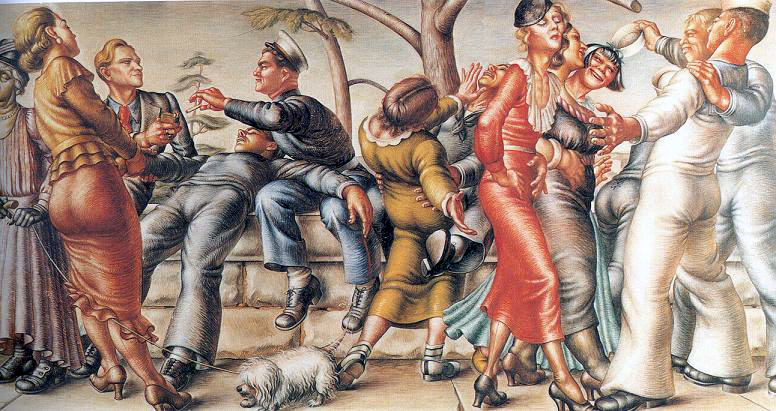
Paul Cadmus, "The Fleet's In"


Paul Cadmus, born December 17th  1904, was an American artist best known for his paintings and drawings of nude male figures.  This painting, with its depiction of two sailors embracing, provoked such an outcry that it was removed from an exhibition at the Corcoran Gallery, Washington, D.C., in a process that foreshadowed the response to Robert Mapplethorpe's work in the 1990s.