Showing posts with label lgbt. Show all posts

Wednesday, 20 February 2013

The Defense of Marriage Act is already losing in the court of public opinion as a case challenging its constitutionality is about to be heard by the US Supreme Court.


A new poll found that 59 percent of Americans are against DOMA after being informed that the law prohibits the federal government from offering benefits to same-sex couples who are legally married.

The percentage of those against DOMA is actually higher than the 52 percent of people in the poll who said they are in favor of gay marriage in general. Also, 62 percent of respondents - including some of those who are against gay marriage - agree that 'it is discrimination for the federal government to deny marriage protections and benefits to legally married same-sex couples.'

'The findings of this poll should provide significant headwinds to LGBT advocates and allies and demonstrate to the Court that the thinking behind DOMA is outdated and indefensible,' said Winnie Stachelberg of the Center for American Progress and Gay & Lesbian Advocates & Defenders which commissioned the poll.
The results of the poll are based on a live interviewer telephone survey conducted January 23 – 27 among 802 registered voters in the US.

Federal appeals courts in New York and Boston ruled that DOMA is unconstitutional - rulings appealed to the Supreme Court by the Republicans.

The justices have agreed to hear the New York case which was filed by Edith Windsor who sued because she was required to pay a $350,000 federal estate tax bill. The government does not recognize her marriage to her late wife Thea Spyer.
Enhanced by Zemanta

Monday, 17 December 2012

Thai government drafting same-sex civil partnership law


 The Thai government has formed a committee to draft legislation on civil-partnership law for same-sex couples.


One of the committee members, Anjana Suvarnananda of LGBT rights group Anjaree told Gay Star News that the committee has already met and the timetable for drafting recognition of same-sex partnerships is six weeks.

'It's just drafting,' said Suvarnananda. 'And then they will send it to a legal department who will iron it out and make it more legal language. And then it needs to get approval from the government. I'm not sure how long it will take.'

No country in Asia currently has comprehensive civil partnership law. So if this legal recognition is passed, Thailand will be the first.

Thailand has a reputation for tolerance for LGBT people but there is no anti-discrimination law (and widespread discrimination) and even though it is a Mecca for sex reassignment surgery, Thai transexuals cannot change the gender written on their official documents. �


Enhanced by Zemanta

Wednesday, 12 December 2012

12 December: Volker Beck, German Politician

b. December 12, 1960


Volker Beck is one of Europe's leading advocates of GLBT rights. A member of Germany's parliament, the Bundestag, Beck is the father of the German Registered Partnership Act
"Human rights that do not apply to everyone are not human rights at all."

Prior to becoming politically active in the peace movement in the 1980's, Volker Beck studied at the University of Stuttgart. In 1985 he joined the Green Party. In 1987, he became responsible for GLBT issues in the Green Party caucus in the Bundestag. From 1991 to 2004, Beck was spokesman for the Lesbian and Gay Association in Germany (LSVD). He is credited with placing the issue of same-gender partnerships and a GLBT anti-discrimination law on the parliamentary agenda.

Beck has represented Cologne in the Bundestag since 1994. He is Green Party Whip for the Alliance 90/Greens caucus, a member of the Greens' party council, and human rights spokesman for the parliamentary group. He was legal affairs spokesman for the Alliance 90/Greens parliamentary group (1994-2002) and political coordinator of the Working Group on Internal and Legal Affairs, Women and Youth within the parliamentary group's executive committee (1998-2002).

Volker Beck believes that Germans must assume responsibility for their history before they can shape a future. He has sought compensation for victims of National Socialism, including financial reparations for persons subjected to slave labor under the Nazi regime, and advocated such acts of remembrance as the construction of a Holocaust memorial. Beck serves as a trustee of several foundations that remember victims.
Since 1992 he has lived with his partner in Cologne, Paris and Berlin.

In May 2006, Beck was attacked and injured by right wing extremists at Russia's first gay rights rally in Moscow. Images of his bloodied face published in the media evoked strong reactions internationally.

Bibliography:
Enhanced by Zemanta

Tuesday, 4 December 2012

Bishop Otis Charles

b. April 24, 1926

Bishop Charles was the first openly gay bishop in any Chrisitian denomination.

From LGBT Religious Archives:
Since 1979 he has been among a growing number of bishops who have spoken out for full and complete inclusion of gay and lesbian people in the church without restriction, recognizing their calling to ministry and rejecting the notion that a baptized homosexual must live a celibate life. In 1980, he was the recipient of the national Integrity Award. He is represented in Out in the Workplace: Gay and Lesbian Professionals Tell Their Stories.
Upon his retirement in 1993, Charles publicly announced his homosexuality, becoming the first openly gay bishop of any Christian denomination. That September he sent an epistle to his colleagues in the House of Bishops that said, in part: "I have promised myself that I will not remain silent, invisible, unknown. After all is said and done, the choice for me is not whether or not I am a gay, but whether or not I am honest about who I am with myself and others. It is a choice to take down the wall of silence I have built around an important and vital part of my life, to end the separation and isolation I have imposed on myself all these years."
John McNeil, former Jesuit and author of Freedom, Glorious Freedom speaks of Bishop Charles' coming out as "an extraordinary example (of the) public exposure... required... to... provide an image... of what it is to be mature as Christian and as gay" (pp.82-83). In Last Watch of the Night, Paul Monette wrote of Bishop Charles' coming out as "an important moment in gay and lesbian history, and a ringing challenge to the status quo of invisibility" (p. 304).
The Sunday edition of the New York Times (October 10, 1993) as well as both gay and straight press around the country reported the bishop's action. Boston's Bay Windows editorialized: "the news of a 67 year old bishop coming out of the closet is something at which to marvel. Charles puts it less grandly, however, saying simply that it was a matter of integrity."
After making his public witness Bishop Charles, who appreciates being addressed by his baptismal name, Otis, has welcomed the opportunity to share his story. Whether in an informal gathering or the pulpit, he characteristically begins, "I am a gay man, an Episcopal (Anglican) bishop, a queer who only just mustered the courage to publicly acknowledge the truth of my life."
Charles has continued as an active and voting member of the Episcopal House of Bishops taking many stands on behalf of his community. In 1995, Charles co-founded Oasis/California, the Bay Area Episcopal Lesbian and Gay ministry. In 1998, Charles was appointed Interim Dean of the School for Deacons serving northern California. During this time he also served as  Bishop-in-residence at the Church of St. John-the-Evangelist in San Francisco and a founding editor of Millennium3, an on-line and print publication distributed to all 13,600 Episcopal clergy. He was an Assisting Bishop in the Diocese of California until 2004.
Charles is currently working on his memoirs and editing a collection of personal reflections on the contribution of entheogens as an opening to mystical experience. Since 1993 he has been a resident of San Francisco where he lives with his partner, Felipe Sanchez Paris.

Wednesday, 21 November 2012

Cherry Jones, Actress

b. November 21, 1956

I was never in the closet. From the moment…I stepped onto the theatrical stage, I was always out. It was never an issue.”

Cherry Jones is a theater, film and television actress best known for her role as president of the United States on the FOX series “24.” A Broadway veteran, Jones is considered one of America’s foremost stage actresses. She has received two Tony Awards.

Jones grew up in the small town of Paris, Tennessee. Her mother taught high school and her father owned a flower shop. “I came from a very loving family where I knew I had their unconditional love no matter what,” Jones says.

With her sights set on acting, Jones enrolled at the prestigious Carnegie Mellon School of Drama, where in 1978, she earned a Bachelor of Fine Arts degree. In 1980, Jones became a founding member of the American Repertory Theatre in Cambridge, Massachusetts, where she played a wide range of roles.

In the mid-1980’s, Jones moved to New York and performed in Broadway productions including “Angels in America,” “The Night of the Iguana” and “A Moon for the Misbegotten.” In 1995, she received a Tony Award for her role in “The Heiress” and made headlines by being the first award winner to publicly thank her same-sex partner.

In 1998, Jones narrated a documentary film about the history of the gay rights movement, “Out of the Past.”
On the silver screen, Jones appeared in “The Horse Whisperer” (1998), “Cradle Will Rock” (1999), “Erin Brockovich” (2000) and “The Perfect Storm” (2000), among others.

In 2001, Jones costarred with Brooke Shields in the Lifetime Television movie “What Makes a Family,” based on the true story of a lesbian couple and a custody battle. “I’m more proud of that than anything I’ve ever done. There’s so much social worth to that film,” Jones says.

Jones is an outspoken advocate of gay rights. In 2004, she received GLAAD’s Vito Russo Media Award for her contribution toward eliminating homophobia.

In 2005, Jones was honored with a second Tony Award for her portrayal of Sister Aloysius in “Doubt.” After receiving the award, Jones thanked and kissed her partner, actress Sarah Paulson.

In 2009, Jones received an Emmy Award for Best Supporting Actress in a drama series for her role on “24."


Bibliography


Television


Films


Enhanced by Zemanta

Friday, 9 November 2012

November 10: Phyllis Lyon & Del Martin, Pioneer Lesbian Activists

Del Martin 
 
b. May 5, 1921
d. August 27, 2008
 
Phyllis Lyon 
 
b. November 10, 1924

"Two extraordinary people ... that have spent the greater part of a half century ... fighting for their right to live the way so many of us, frankly, take for granted."
 San Francisco Mayor Gavin Newsom


Del Martin and Phyllis Lyon founded the first lesbian organization in the United States and have fought for more than 50 years for the rights of lesbians and gays. On June 16, 2008, Martin and Lyon became the first gay couple to be legally married in California.

Martin and Lyon both earned degrees in journalism. While working as journalists in Seattle, the two became romantically involved. The couple relocated to San Francisco and moved in together on Valentine’s Day 1953.

In 1955, finding it hard to develop a social network in San Francisco, Martin, Lyon and a small group of women founded the first lesbian organization, called the Daughters of Bilitis. The name was inspired by Pierre Louys’s “Songs of Bilitis,” a collection of poems celebrating lesbian sexuality.

Though it was intended to be a secret society, Martin and Lyon wanted to make the Daughters of Bilitis more visible. The group began publishing a monthly magazine, called The Ladder, which was the first-ever lesbian publication. As editors of the magazine, they capitalized the word “lesbian” every time it appeared.

In 1964, while fighting to change California sex laws criminalizing homosexuals, the couple joined religious and gay community leaders to form the Council on Religion and the Homosexual (CRH). This organization was at the forefront of the movement to gain religious support on gay rights issues. Both women served on the founding CRH board of directors.

In 2004, when gay marriage was offered in San Francisco, Martin and Lyon were the first to wed. A California appellate court ruling subsequently invalidated their marriage. Then in May 2008, a California Supreme Court decision provided same-sex couples the right to marry. On June 16, 2008, they were the first same-sex couple married in California. The wedding was officiated by San Francisco Mayor Gavin Newsom.

Martin and Lyon have published two books together, “Lesbian/Woman” (1972) and “Lesbian Love and Liberation” (1973). On their 50th anniversary, the documentary “No Secret Anymore: The Times of Del Martin and Phyllis Lyon” premiered. In 2005, the National Gay and Lesbian Journalists Association inducted Martin and Lyon into the LGBT Journalists Hall of Fame for their pioneering work on The Ladder. In 2007, they received the 2007 Gay and Lesbian Alliance Against Defamation (GLAAD) Pioneer Award.

Bibliography
Del Martin & Phyllis Lyon.” (The Lesbian, Gay, Bisexual and Transgender Religious Archives Network).

Kornblum, Janet. “Gay Activists Blaze Trail for half century.”  USA Today. March 4, 2004


Streitmatter, Rodger.  “Phyllis Lyon & Del Martin.”  National Lesbian & Gay Journalists Association: LGBT Journalists Hall of Fame.  June 5, 2008

Articles
Gordon, Rachel. “Lesbian Pioneer Activists See Wish Fulfilled.” San Francisco Chronicle. June 16, 2008

Marshall, Carolyn. “Dozens of Gay Couples Marry in San Francisco Ceremonies.” The New York Times. February 13, 2004

McKinley, Jesse. “Same-Sex Marriages Begin in California.” The New York Times. June 17, 2008

Books
Lesbian love and liberation (The Yes book of sex) (1973)
Battered Wives (1976)

Other Resources


Enhanced by Zemanta

Thursday, 8 November 2012

The Art of George Quaintance


Discrimination no longer an electoral asset

November 6th 2012 was a great day for LGBT political progress to equality, at all levels of American government.


Marriage ballots

Voters had never before approved marriage equality in a direct ballot, but this week they did so in four states simultaneously. In Maine, they reversed a ballot decision from 2009, re-instating the law passed earlier that year. In Maryland and Maine, they approved the legislation that had been passed earlier by the state legislatures, and that had been stalled by opponents belief that voters would overturn it. In  Minnesota, voters resisted attempts to entrench marriage discrimination in the state constitution.

This will embolden new marriage initiatives from state legislatures and citizens' ballot propositions, to upgrade civil unions to full marriage, to introduce civil unions where they are not yet available, or to overturn existing constitutional bans. Keep an eye on Rhode Island, Illinois, Delaware, Hawaii, Oregon, and Colorado.

The resounding voter support will also send a strong message to the justices of the Supreme Court, as they decide on how to respond to the assorted appeals - on Proposition 8 in California, and challenges to DOMA. If they decide not to consider the appeal on the Proposition 8 ruling, it will stand. Proposition H8 will have been overturned, and marriage equality will return to the state. If they do take up the issue, they may well agree with the lower court, that Proposition 8 was invalid - but if not, voters will surely take up the issue, as they did in Maine - and will win. Either way, marriage equality will return, and within the next year or two. We just cannot say how, or when.

Congress

Washington will have its largest queer delegation yet. Tammy Baldwin is the first LGBT person elected to the Senate, and three gay men joined two incumbents as congressmen: Mark Takano in California 41, Sean Patrick Maloney in New York, and Mark Pocan in Wisconsin 02.  Kyrsten Sinema in  Arizona 09 became the first openly bisexual Representative elected. Together with the existing Reps Jared Polis (Colorado) and David Cicilline (Rhode Island), that's a total delegation of seven, spanning the East Coast, Midwest, Southwest and West Coast.

States

The big news and headlines have concentrated on the national results, but it is at state and local levels that many of the decisions are made that affect our lives most directly - and there are some really interesting stories lower down the ballot. 

  • In Minnesota, where Republicans in the  state legislature, with Catholic bishops as cheerleaders, initiated the proposed constitutional ban, the GOP lost both houses of the state legislature.
  • In New York, where the NOM and the rest of the religious right went after four GOP state senators who supported gay marriage last year, the Republicans appear to have lost the state senate, which they have held for years. (One key race has not yet been settled, but the Democrat holds a still lead).
  • In Iowa, where the Democrats control the state senate and have resisted attempts to initiate a repeal of gay marriage, the Republicans failed in a determined attempt to take control. Also in Iowa, where two years ago voters unseated three of the judges who had ruled in favour of gay marriage, this year a similar conservative assault on a fourth judge failed. Same - sex marriage in Iowa is here to stay.
  • In Colorado, where the GOP Speaker of the state House blocked a bill for civil unions that would have passed simply by refusing to allow a vote, the Democrats have regained control. Speaker McNulty will soon be ex-Speaker, and is likely to be replaced by  - an openly gay man. Expect civil unions, or even full marriage equality, to feature high on his to-do list for 2013.

This will send a strong message to the opponents of equality in other state legislatures. The National Organisation for Marriage and their allies had promised to demonstrate that Republican support for equality would damage their careers. The reverse is true - it's discrimination, not support for LGBT equality, that is now an electoral liability.


As recently as 2004 the Republican strategist Karl Rove prompted Republicans in key states to put up gay marriage bans in the federal election. The object was to anger the base and draw Christian conservatives and religious black voters out to the polls, and in so doing bolster the vote for George Bush jnr. It worked, and for a time some Republicans believed they could use fear of gay marriage to maintain a permanent majority.
The results across America on Tuesday night appear to put the notion to rest 
- Sydney Morning Herald

State House election gains:

The electoral gains at congressional level were repeated right down the ballot. Gay Politics reports that
Seven state legislatures gained their first or only openly LGBT state lawmakers this year, including North Dakota, South Dakota, West Virginia, New Mexico, Texas, Pennsylvania and Florida, which went from zero to two gay legislators.  And in Oregon and Colorado, state legislative election results have positioned two out lawmakers to become House Speakers.
Those supported by the Victory Fund and elected included:

California - Senate
  • Ricardo Lara
  • Mark Leno

California - State Assembly
  • Tom Ammiano
  • Toni Atkins
  • Susan Eggman
  • Richard Gordon
  • John Perez

Colorado - Senate
  • Jessie Ulibarri
  • Patrick Steadman

Colorado - State House of Representatives
  • Dominick Moreno
  • Paul Rosenthal
  • Mark Ferrandino
  • Joann Ginal
  • Sue Schafer

Florida - State House of Representatives
  • Joe Saunders
  • Dave Richardson-State House of Representatives

Georgia - State House of Representatives
  • Simone Bell
  • Karla Drenner
  • Keisha Sean Waites

Illinois - State House of Representatives
  • Deb Mell
  • Sam Yingling
  • Kelly Cassidy

Massachusetts - State House of Representatives
  • Denise Andrews
  • KateHogan
  • Carl Sciortino
  • Sarah Peake

Maine -  State House of Representatives
  • Justin Chenette
  • Andrew McLean
  • Matt Moonen
  • Terry Morrison

Minnesota - State House of Representatives
  • MN-Scott Dibble

Minnesota -  State House of Representatives
  • Susan Allen

Missouri -  State House of Representatives
  • Mike Colona

Montana -State Senate
  • Christine Kaufmann

Montana-State House of Representatives
  • Bryce Bennett

North Carolina -State House of Representatives
  • Marcus Brandon

North Dakota - State House of Representatives
  • Joshua Boschee

New Hampshire -State Senate
  • David Pierce

New Hampshire -Executive Council
  • Chris Pappas

New Mexico - State Senate
  • Jacob Candelaria

Nevada - State Senate
  • NV-David Parks

Nevada - State Assembly
  • James Healey
  • Andrew Martin

New York- State Senate
  • NY-Brad Hoylman

New York - State Assembly
  • Harry Bronson
  • Matthew Titone
  • Danny O’Donnell

Ohio - State House of Representatives
  • Tim Brown
  • Nickie Antonio

Oklahoma - State Senate
  • Al McAffrey

Oklahoma - State House of Representatives
  • Kay Floyd

Oregon - Secretary of State
  • Kate Brown

Oregon - State Supreme Court
  • Virginia Linder


Oregon - State House of Representatives
  • Tina Kotek

Pennsylvania - State House of Representatives
  • Brian Sims

Rhode Island-State Senate
Donna Nesselbush
Rhode Island-State House of Representatives
  • Gordon Fox
  • Deb Ruggiero
  • Frank Ferri

South Dakota -State Senate
  • Angie Buhl

Texas - State House of Representatives
  • Mary Gonzalez

Vermont -State House of Representatives
  • Herb Russell 
  • Matt Trieber
  • Suzi Wizowaty

Washington -State House of Representatives
  • Jamie Pederson
  • Marko Liias
  • Jim Moeller
  • Wisconsin

WI - State Assembly
  • JoCasta Zamarripa

West Virginia -State House of Delegates
  • Stephen Skinner

Wyoming -State House of Representatives

  • Cathy Connolly

That's a long list, but it's incomplete. There will be more who should be added: there are others who did not seek or accept help from the Victory Fund, some races are still not yet decided (pending absentee or provisional vote counting, and recounts), and others may have been omitted in simple error. 

Then there's a whole slew of new representatives elected still lower down - ballot, at local level - but I'm not going into that. See the complete list (including also the candidates who lost) at Gay Politics' Victory Fund Celebrates Huge Night for Gay Candidates

  
Enhanced by Zemanta

Saturday, 3 November 2012

Georgina Beyer,Trans Politician

? November 1957

“It is important to allow people who want to be positive contributors of our society regardless of sex, race, creed and gender to reach their human potential.”


“It is important to allow people who want to be positive contributors of our society regardless of sex, race, creed and gender to reach their human potential.”

As the first openly transgender person in the world to hold a national office, Georgina Beyer was elected a member of Parliament in New Zealand. Beyer’s transformation from stripper and prostitute to politician is a testament to her remarkable fortitude.

Beyer, born biologically male, spent her early childhood on her grandparents’ farm in rural New Zealand before moving to Wellington with her mother and stepfather. From an early age, Beyer recalls feeling like a girl trapped in a boy’s body.

In her 20’s, Beyer began working in the Wellington gay nightclub scene as a singer and drag queen performer, and then a prostitute. During a trip to Australia, she was attacked and raped by four men. Beyer refers to this experience as her defining moment.

In 1984, she had sexual reassignment surgery and forged a successful career as a film and television actress in Auckland. She was often typecast as a drag queen or streetwalker. From Auckland, Beyer moved to the small conservative town of Carterton, where she took a job as a youth social worker.

In 1993, Beyer was elected to the Carterton District Council. Two years later she was elected Mayor of Carterton, where she served for five years. In 1999, she won a seat in the New Zealand Parliament. While in Parliament, Beyer helped pass the Prostitution Reform Act, which decriminalizes prostitution and protects sex workers and their clients. She was instrumental in securing same-sex civil union benefits for New Zealanders.

Beyer chronicled her life in “Change for the Better: the Story of Georgina Beyer” (1999). A documentary film about her, “Georgie Girl” (2002), won international awards.

Beyer was a keynote speaker at the International Conference on LGBT Human Rights in Montreal in 2006. She retired from Parliament in 2007, saying, “I can now look for fresh challenges.”

Bibliography


Articles


Books


Films


Interviews


Websites


Enhanced by Zemanta

Friday, 2 November 2012

k.d. lang, Singer/Songwriter

b. November 2, 1961
"I'm proud that I was one of the first ones out, singing loud and proud.”

k.d. lang is a singer/songwriter known for her stunning voice, androgynous look and brilliant performances. She has been a recording artist for over 25 years, winning four Grammy Awards and countless accolades from critics and audiences worldwide. 

Born Kathryn Dawn Lang, she was raised in Consort, Alberta, on the Canadian prairie. After winning a childhood singing competition, Lang knew she was destined for a career as a vocalist. Starting in the country music genre, she earned a Juno Award (Canada’s equivalent to the Grammy) for Most Promising Female Vocalist in 1985. 

“Angel with a Lariat,” her first U.S. album, received critical acclaim. Lang’s duet with Roy Orbison on his 60’s hit, “Crying,” turned her into a bonafide star. In 1989, the pair received a Grammy for Best Country Collaboration 

Absolute Torch and Twang” (1989), another country album, won Lang her second Grammy. “Ingénue” (1992), a collection of pop contemporary vocals, was Lang’s most successful. The album went platinum, earning her a third Grammy and launching the hit single “Constant Craving.”

After touring with veteran crooner Tony Bennett in 2001, the duo collaborated on “A Wonderful World” (2002), a tribute to the music of Louis Armstrong. The album was honored with a Grammy for Best Traditional Pop Vocal Album. 

Bennett described Lang as “a natural in the tradition of Bing Crosby—the best singer since Judy Garland.” 
Lang has contributed music to a number of motion pictures, including Gus Van Sant’s “Even Cowgirls Get the Blues,” Clint Eastwood’s “Midnight in the Garden of Good and Evil,” and the James Bond film “Tomorrow Never Dies.” 

In 1992, Lang came out in an interview with The Advocate. She has actively championed GLBT civil rights causes and helps raise funds for HIV/AIDS care and research. 

In 2008, k.d. lang received a star on Canada’s Walk of Fame.  


Bibliography


Books about k.d. lang


CD’s


DVD’s


Films


Television


Videos


Websites


Enhanced by Zemanta

Tuesday, 28 August 2012

Keith Boykin, Political Commentator

b. August 28, 1965
“I'm not on a show with a pink triangle or rainbow flag—which means that being gay is just a part of who I am.”


Keith Boykin is a political commentator, a New York Times best-selling author and a veteran of two presidential campaigns. He is the editor of The Daily Voice and has appeared on CNN, MSNBC and BET.

Born and raised in St. Louis, Missouri, Boykin became politically focused working on local campaigns while in high school. At Dartmouth he was the editor of the daily newspaper and graduated with a B.A. in government.

After college, Boykin worked on the Dukakis presidential campaign. Thereafter, he attended Harvard Law School and continued working on campaigns, including the 1992 presidential campaign of Bill Clinton. Boykin worked as special assistant to the president and served as President Clinton’s liaison to the LGBT community.

In 1994, Boykin became the executive director of the National Black Lesbian and Gay Leadership Forum and completed his first book, “One More River to Cross: Black and Gay in America.” In 1997, he served with Coretta Scott King and the Rev. Jesse Jackson on the U.S. presidential trade delegation to Zimbabwe.

Boykin wrote two other books, “Respecting the Soul” (1999) and “Beyond the Down Low: Sex, Lies and Denial in Black America” (2005). His work shed light on AIDS, internalized homophobia and black men on the “down low.”

Boykin is a commentator on major political talk shows. In 2004, he starred on Showtime’s “American Candidate” and hosted BET’s “My Two Cents.”

Keith Boykin is working on a fourth book, “For Colored Boys Who Have Considered Suicide When The Rainbow Is Still Not Enough.” He lives in New York City.

Bibliography

  • "Keith Boykin, Author, Beyond the Down Low." Gothamist. 8 June 2011.
  • “Keith Boykin - TV Host/Author/Speaker.” Keith Boykin. 8 June 2011.
  • Malmgren, Jeanne. "The way he sees it." St. Petersburg Times Online. St. Petersburg Times. 8 June 2011.


Websites


Books

  • One More River to Cross: Black & Gay in America (1997)
  • Respecting the Soul: Daily Reflections for Black Lesbians and Gays (1999)
  • Beyond the Down Low: Sex, Lies, and Denial in Black America (2005)
Enhanced by Zemanta

Sunday, 19 August 2012

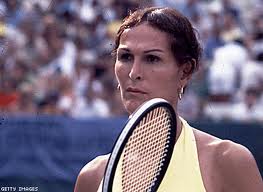
Renée Richards, Transgender Athlete

Transgender Pioneer
b. August 19, 1934
I made the fateful decision to go and fight the legal battle to be able to play as a woman and stay in the public eye and become this symbol.


Dr. Renée Richards became a transgender icon in 1977 when she won a lawsuit against the United States Tennis Association. Richards sued the Association for its refusal to let her compete in the U.S. Open women's division following male-to-female gender reassignment surgery. In a landmark decision, the New York Supreme Court ruled in Richards's favor.


Richards started playing tennis at an early age. Ranked among the top-10 eastern national juniors, she won the Eastern Private Schools' Interscholastic singles title at age 15. She captained her high school tennis team at the Horace Mann School in New York City and Yale University's men's tennis team in 1954.


In 1959, Richards graduated from University of Rochester Medical School. After serving in the Navy as Lieutenant Commander, she pursued a career in ophthalmology and eye surgery while continuing to compete in tennis tournaments.


At the height of her tennis career, Richards ranked 20th in the nation. In her first tennis tournament as a female, she reached the semifinals in the U.S. Open women's doubles competition. Following retirement, Richards coached tennis star Martina Navratilova. In 2000, the U.S. Tennis Association inducted Richards into its Hall of Fame.


Richards has published two autobiographies: "Second Serve Renée" (1986), also a TV-movie, and "No Way Renée: The Second Half of My Notorious Life" (2007). She is a renowned eye surgeon and professor of ophthalmology at the New York University School of Medicine.


Bibliography
“The Second Half of My Life.” NPR: Talk of the Nation. February 8, 2007
Fee, Elizabeth, Theodore M. Brown and Janet Taylor. "One Size Does Not Fit All in the Transgender Community." Journal of Public Health, 93.6. June 2003
Selected Works
No Way Renée: The Second Half of My Notorious Life (2007)
Second Serve (1986)
Enhanced by Zemanta